A Series of Deccani Miniatures:
Imaginary Creatures Invented for a Princely ‘Keepsake’
DOI:
https://doi.org/10.52476/trb.25557Abstract
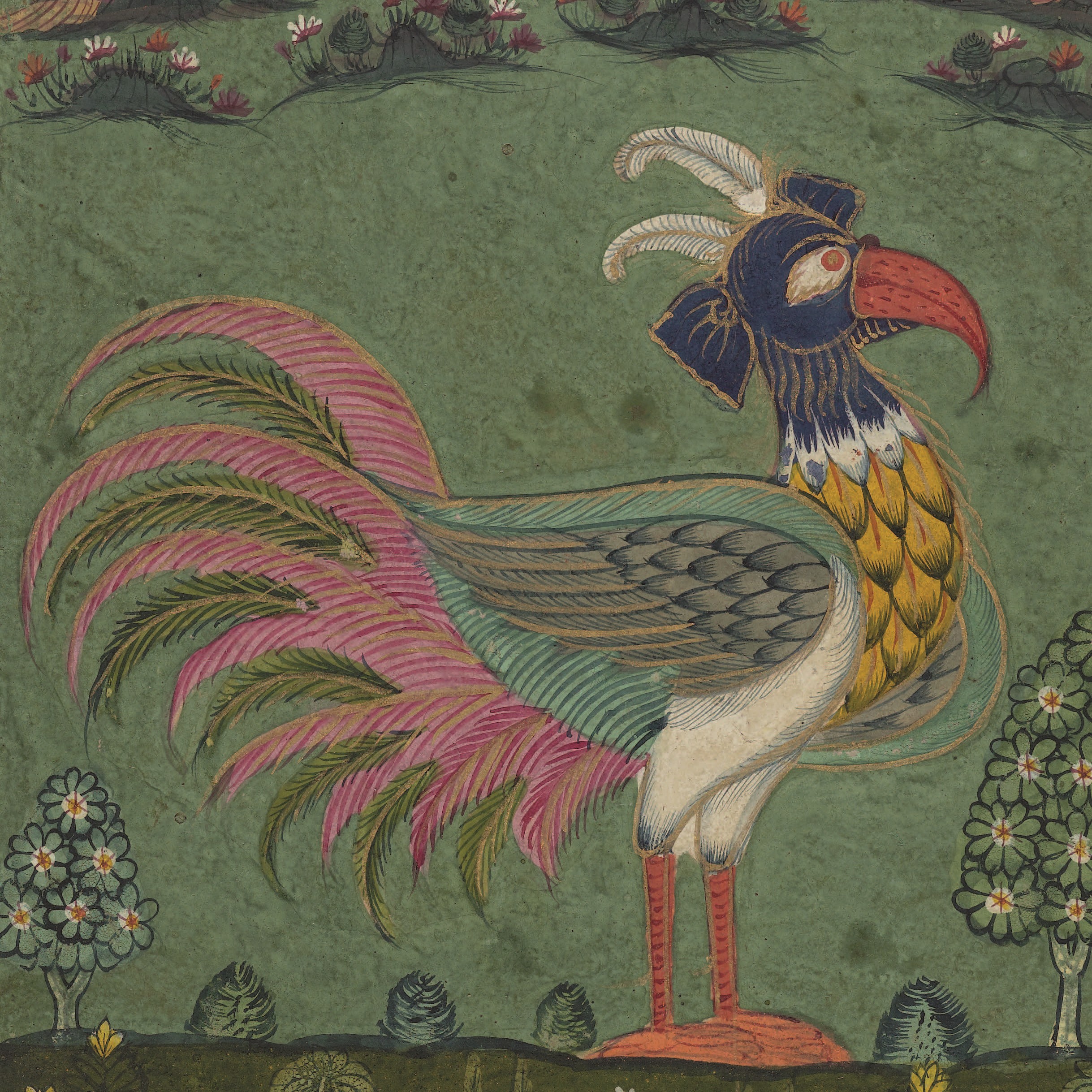
The Mythical Bird, preserved in the Rijksmuseum, belongs to a series of Deccani miniatures showing varied and hybrid creatures dispersed by Maggs Bros between 1966 and 1972. All the miniatures share the same composition, in the foreground featuring a strange creature standing in a grassy landscape that extends into a faraway vista filled with a variety of comparatively diminutive buildings, tiny people and animals. On the verso of the miniatures that could be consulted, we find an inscription in Persian script describing a creature very different from what is depicted on the recto, enabling us to reconstruct the original sequence of the set. Some of the miniatures remind us of illustrations in the manuscripts forming part of Qazwini’s encyclopaedia, the Aja’ib al makhluqat, one of the most famous works from the Islamic medieval period. Translated into Persian, Greek and Turkish, this book remained popular for centuries. Qazwini includes stories about Iskandar (Alexander the Great) but also tales of imaginary creatures and monsters. The Abbasid period is an era marked by great maritime discoveries, when navigators and adventurous traders wrote their memoirs describing unexplored lands and strange creatures that became legendary. During the seventeenth and eighteenth centuries, courtiers in the sultanates of the Deccan patronized art and were traditionally very interested in literature, magic, cosmology, astronomy and strange and wondrous creatures. Members of the Asaf Jahi dynasty in the city of Aurangabad, for instance, were great enthusiasts. On the basis of large painted canvases produced in an Aurangabad workshop, depicting the theme of Barahmasa (the twelve months), Sultan Salabat Jang is suggested as the possible patron of the present set of miniatures.
Downloads
Downloads
Published
Issue
Section

How to Cite