Lou Loeber:
Archivist of her Own Oeuvre
DOI:
https://doi.org/10.52476/trb.28933Abstract
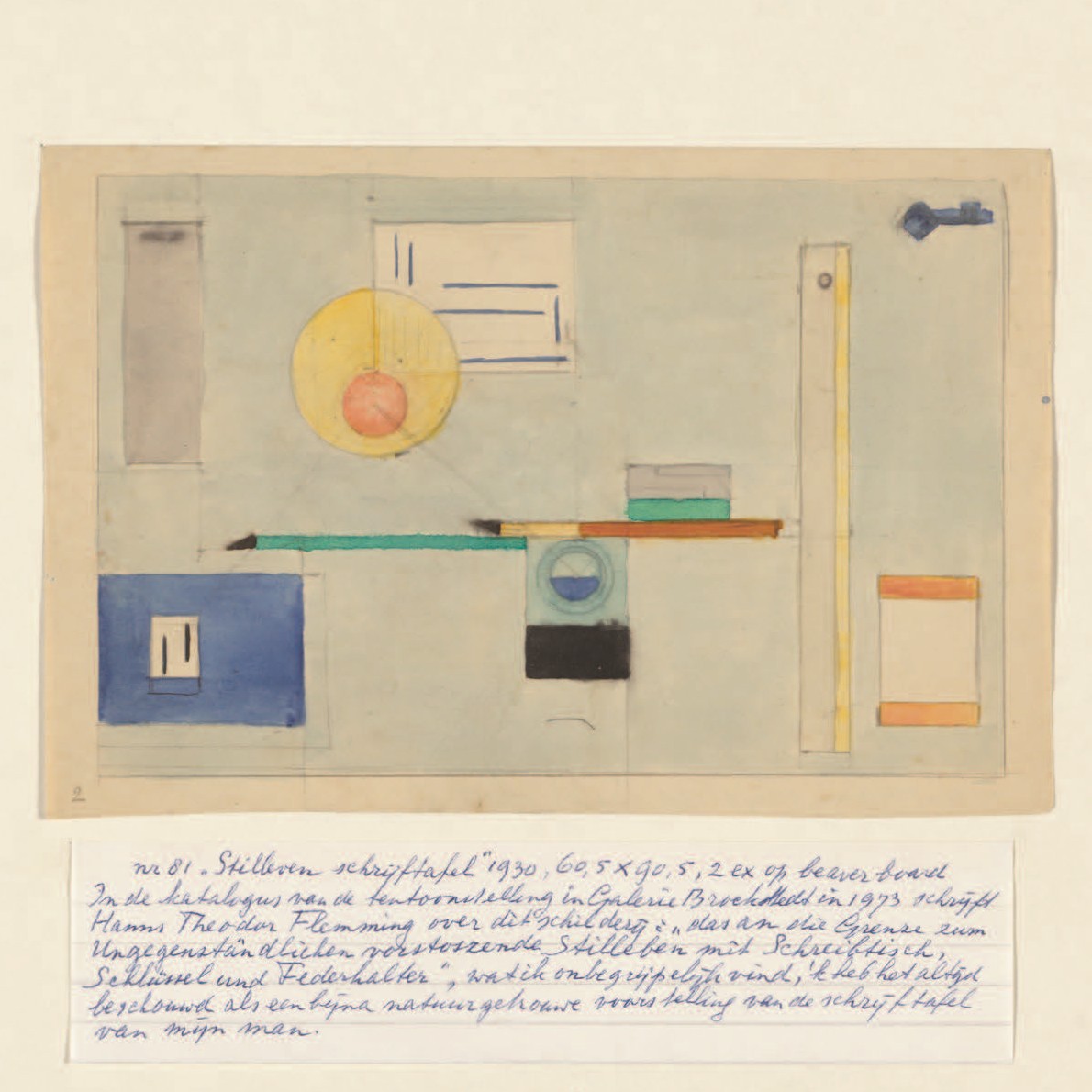
In 1983, the artist Lou Loeber (1894-1983) donated over two hundred of her own characteristically abstracted and constructivist prints and drawings to the Rijksmuseum Print Room. In close consultation with museum curators, she provided handwritten annotations for a significant number of her sketches, which at the time and still today provide insight into the interpretation of her work. The present article situates this unique donation within the context of the renewed appreciation for Loeber’s work that emerged in the nineteen seventies, arising from a growing interest in both interwar abstract art and women artists. It shows how Loeber navigated a new network of artists, galleries and museums, and how – when confronted with various interpretations of her work – she consistently returned to her own socialist vision of art. Only very rarely did Loeber herself take steps for her artworks to be acquired in public collections. By means of her donation to the Print Room, the publication of her memoirs and bequeathing her artist’s archive, Loeber lent her artistic legacy an autobiographical quality, enabling her to shape the public perception of her person and her existence as an artist effectively. This case study therefore contributes to our knowledge of women acting as custodians and donors of artists’ legacies, on their own behalf as well as that of others.
Downloads
Downloads
Published
Issue
Section

How to Cite